On Tuesday, March 25, Canada and Alberta announced an agreement in principle on methane emissions.
The agreement is part of an ongoing effort to finalize the Canada-Alberta MOU, which commits both governments to reach deals in four key areas: industrial carbon pricing, methane regulation, the Pathways Alliance carbon capture project, and cooperation on environmental assessments.
The deal would let Alberta regulate its own methane under a provincial system, with a target of 75% reduction from 2014 levels by 2035. Both governments called it a step forward. Ottawa said it would stand down federal methane regulations in Alberta in exchange for equivalent provincial action. An independent third party would be brought in to verify the results.
But forty-eight hours later, Alberta’s Energy Regulator released new methane rules that appear to undercut the agreement the province had just signed.
The Calgary-based Pembina Institute reviewed the AER’s amendments to Directive 060 — the technical regulation governing flaring, incineration, and venting in the upstream oil and gas sector — and found them weaker than federal standards in several specific ways.
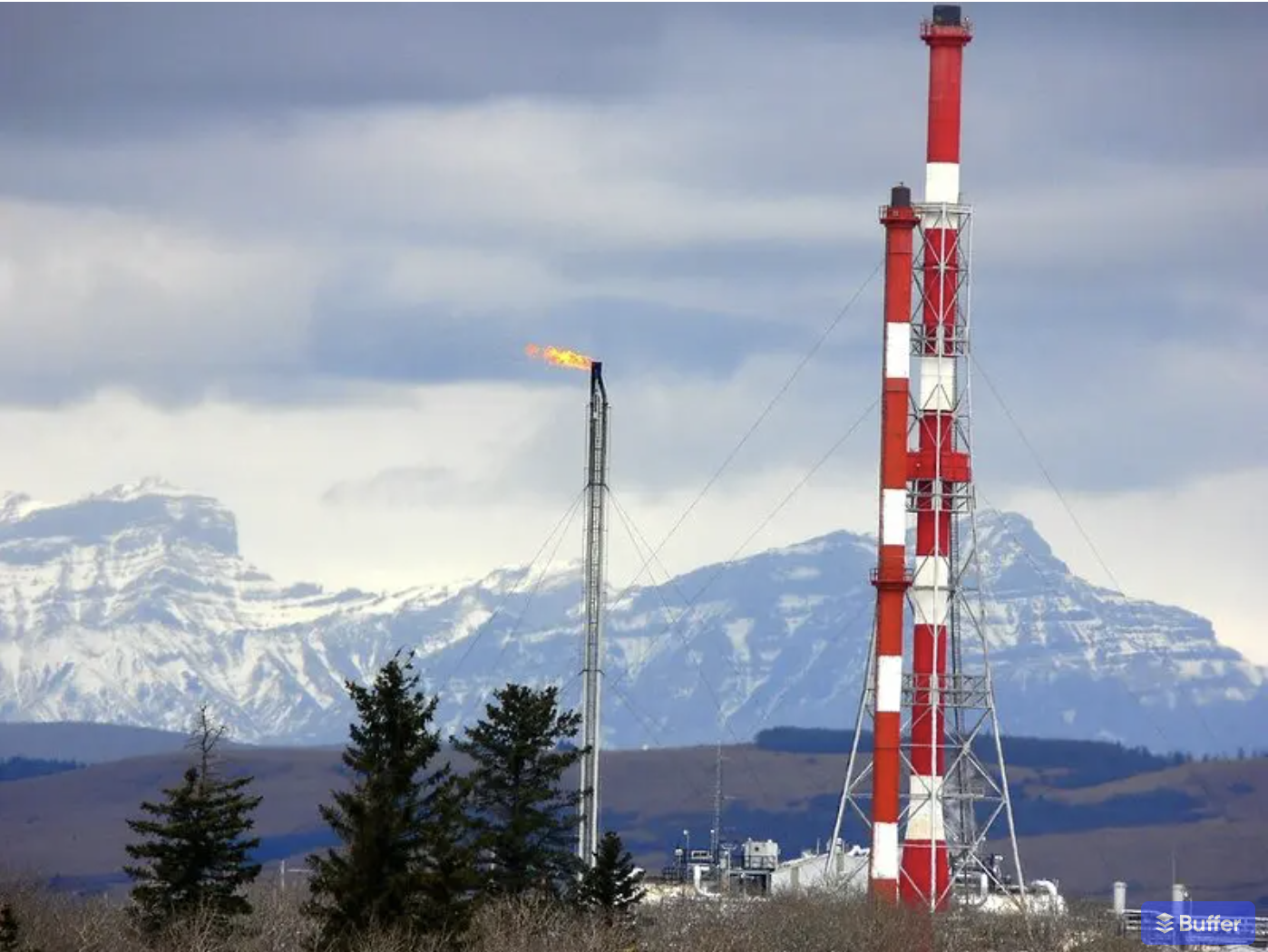
Where federal regulations prohibit routine venting of methane entirely, Alberta’s new rule only limits venting volumes from a single source. There is no plan to phase out emitting pneumatic devices — something the federal government, British Columbia, and Saskatchewan are all moving toward. Alberta’s flaring controls fall short of a federal requirement for an engineering study to justify any routine flaring. And there is no equivalent to federal leak detection and repair requirements.
Amanda Bryant, head of Pembina’s oil and gas program, did not mince words. The draft provincial regulation, she said, is clearly weaker than the federal one — and she would not expect it to be deemed legally equivalent under the forthcoming equivalency process.
This matters because methane an important driver of climate change. It carries roughly 80 times the global warming potential of carbon dioxide over a 20-year horizon. The IPCC identifies methane reduction as one of the cheapest, fastest paths to meaningful emissions cuts. And it is overwhelmingly cost-effective — capturing methane means capturing natural gas that can be used or sold, which is why over 50 international oil and gas companies have voluntarily pledged to virtually eliminate methane emissions by 2030.
Given the stakes, the agreement in principle should have been straightforward. In some respects, it is. In others, it leaves important gaps that raise questions about how effectively Alberta will actually cut methane emissions.
What the Agreement in Principle Says
The deal sets a target of 75% reduction in methane from 2014 levels by 2035. A draft equivalency agreement is to be published later this year for a 60-day public comment period, with the goal of finalizing it by year-end. The agreement would take effect no later than January 1, 2027, and last for 10 years.
That target is already a significant concession from the federal target — a 72% reduction from 2012 levels by 2030. Alberta gets five extra years and a more favourable baseline. The Environmental Defense Fund has said that giving Alberta a five-year extension on the 2030 target makes the regulations 36% less effective and wastes up to $530 million in natural gas that could otherwise be captured and sold.
But beyond that, two things stand out about what the agreement leaves out.
First, there is no mention of the federal government’s own 2030 target — a 72% reduction from 2012 levels — which was finalized in the Enhanced Methane Regulations published in December 2025 and applies to all of Canada.
Environment Minister Dabrusin told CBC’s Power and Politics in December that Alberta’s 2035 target is in addition to, not a replacement for, the 2030 target. But the agreement in principle is silent on how that earlier deadline will be enforced.
Second, the agreement commits both governments to jointly select an independent third party to conduct methane modelling and verify results. It does not, however, specify whether the third party will rely on actual atmospheric measurement — satellites, aircraft, vehicle-based monitoring — or on the theoretical modelling and industry self-reporting that Alberta currently uses.
That matters — because independent research shows that Alberta’s approach to measuring methane, relying on industry self-reporting, may understate actual emissions by roughly half.
The Measurement Problem
One week before the agreement in principle was announced, the Pembina Institute published a technical analysis that challenges the centrepiece of Alberta’s case for self-regulation: the province’s claim to have reached its 2025 methane reduction target — a 45% cut from 2014 levels — two years ahead of schedule.
That claim rests entirely on outdated estimation techniques and self-reporting by industry. When independent researchers use actual measurement — satellite data, aircraft surveys, ground-level monitoring — the picture looks very different. Federal government data puts Alberta’s reductions at 35% below 2014 levels as of 2023, not the 52% the province claims. And the broader body of peer-reviewed research suggests actual emissions may be up to 90% higher than Alberta’s official estimate.
Alberta’s approach lowers the bar for the emissions it needs to cut to reach its targets. Canada’s National Observer reported that if the equivalency agreement relies on federal data, industry needs to cut roughly 8 megatonnes of methane. If it relies on Alberta’s numbers, the required reduction drops to about 3.5 megatonnes. Less than half the effort for the same headline target.
None of this haggling over measurement should be necessary. British Columbia uses federal data to track its methane progress, has regulated reductions of 75% by 2030 from 2014 levels — five years earlier than what Alberta is now proposing — and has cut emissions by 51% while increasing natural gas production by more than 67%. The province has demonstrated that strong methane regulation imposes no penalty on production. Alberta has not made that case.
A Pattern of Behaviour
Alberta is rejecting a perfectly good federal framework for measuring methane — one that other provinces already use. The federal government has tried to meet the province halfway, negotiating an arrangement that gives Alberta its own approach while keeping the numbers credible. Alberta agreed in principle. And then, within 48 hours, it moved to undermine what it had just signed.
Unfortunately, this is forming a pattern.
When the Canada-Alberta MOU was signed on November 27, 2025, Ottawa made sweeping concessions — scrapping its planned oil and gas emissions cap, dropping clean electricity regulations in Alberta, delaying methane targets by five years. In exchange, Alberta committed to meaningful industrial carbon pricing, the Pathways Alliance carbon capture project, and cooperation on methane.
Within days though, Alberta pushed through regulatory changes that flooded its carbon credit market with additional tradeable credits, crashing the actual price to below $20 per tonne — in a system where the MOU committed the province to an effective price of $130. Pembina called it moving the goalposts before negotiations had begun.
Now the same thing has happened with methane. The agreement in principle was signed Tuesday and weaker AER regulations were released Thursday. Pembina’s Bryant confirmed the parallel: “I think this is a fair comparison. An agreement to cooperate, followed by immediate action that obviously contradicts the letter and the spirit of the agreements.”
Some say this pattern goes back even further. In 2018, the Trudeau government bought the Trans Mountain pipeline in exchange for Alberta’s commitment to climate action. The oil industry said it supported the plan. Then they fought the regulations they had agreed to. Catherine McKenna, the environment minister who negotiated that deal, was asked recently whether she would trust the oil companies again. Her answer: “I would never trust them.”
All this raises a question that Canadians deserve an honest answer to: can this process work when one party consistently signs agreements and then immediately takes steps to undercut them?
The Good Faith Question
The MOU was a significant concession by Ottawa. The federal government gave up the oil and gas emissions cap — a regulation that had not yet taken effect but represented real policy ambition. It suspended the Clean Electricity Regulations in Alberta. It delayed methane targets by five years, at a cost that Pembina has quantified: 1.9 million extra tonnes of methane released into the atmosphere, equivalent to 53 million tonnes of CO₂ — the same as the annual pollution from roughly half the cars on Canada’s roads.
These were not symbolic gestures. They were effective policies that were helping Canada reduce its emissions — policies designed to protect Canadians against the worst effects of climate change on our environment, our economy, and our well-being. They were traded away to secure Alberta’s cooperation.
And what happened? On carbon pricing, Alberta crashed its own credit market within a week. On methane, Alberta released weaker regulations within 48 hours. On the pipeline — the centrepiece of the deal — no private proponent has come forward, and Premier Smith has already said the April deadline will be missed.
At some point, you have to ask: what exactly are we doing here?
Alberta claims to have robust provincial climate policies. But it has systematically undermined them — freezing its carbon price below the federal standard, relying on an honour system for methane measurement, stifling renewable energy investment. Ottawa responds by making concessions, weakening national policies in exchange for commitments that Alberta immediately walks back.
The Canadian Climate Institute’s Rick Smith put it plainly when the MOU was signed: “At a time when Canadian climate change policy needed increased certainty, today’s MOU does the opposite. Carve-outs for Alberta invite copycat demands from other provinces and territories, and could trigger more policy fragmentation across Canada.”
That fragmentation is already happening. Saskatchewan has defied the federal carbon backstop. Nova Scotia demanded its own carve-out. The consumer carbon tax is gone.
Maybe Guilbeault Was Right
Steven Guilbeault, Canada’s former Minister of Environment and Climate Change, resigned from cabinet over the MOU. It was a dramatic gesture, and at the time, some commentators dismissed it as grandstanding. But maybe his core argument deserves a second look.
Canada has regulations. The Supreme Court has confirmed that Ottawa has jurisdiction over industrial carbon pricing. The Enhanced Methane Regulations finalized in December 2025 are law. Guilbeault’s position was simple — we should just enforce them.
“We have to tell those who want to do that that, ‘actually, you can’t break the law,’” he said, “just like you can’t break criminal laws.”
His specific warning about carve-outs has been vindicated by events. “If there’s a carve-out for Alberta, then there’ll be a carve-out for everyone else,” he said — and pointed to exactly what happened with the consumer carbon tax. The Atlantic provinces demanded a carve-out for heating oil. They got it. The tax was scrapped nationally within 18 months.
Perhaps, when you bend the rules for an unreliable partner, they see it as an opportunity to break them.
I am not saying that federal-provincial cooperation is impossible, or that Ottawa should abandon negotiation in favour of unilateral enforcement. The Canadian Climate Institute’s Alison Bailie makes a fair point that Canada has historically achieved greater emissions reductions when governments work together. Collaboration can work.
But collaboration requires good faith from both sides. And good faith means, at a minimum, not releasing regulations that contradict an agreement you signed 48 hours earlier.
At some point, Ottawa will have to decide whether it is negotiating a climate policy — or negotiating against one.
Leave a Reply